The Narrator Suddenly Rages and Awakens
The Character of RainThe Narrator Suddenly Rages and Awakens is the turning point at which the child’s two-year, tube-like passivity gives way to movement, fury, and apparent life. The awakening is startling not because its cause is explained, but because a domestic day without any apparent significance becomes, in retrospect, a decisive beginning: the family recognizes a change that the specialists cannot account for, and the narrator frames it as one of history’s unmarked pivotal moments.
Before the Awakening
The scene begins in a household that appears to be following its ordinary rhythms. The parents act as parents, the other children behave as children, and the child remains enclosed in its cylindrical existence. This calm is not merely the quiet before an incident. It represents the condition that has defined the child for two years, making the sudden eruption difficult for the family to recognize at first as a change within the child itself. The narration emphasizes the day’s insignificance as it happens. It will become the most important day of the child’s life, yet then disappear without a trace. The comparison with humanity’s first rise to its feet and its first understanding of death places the awakening within a pattern: profound changes may happen without witnesses recognizing their historical weight. The event’s importance is therefore supplied by the narrator’s retrospective framing, not by ceremony or foreknowledge in the household.
The Child’s Sudden Change
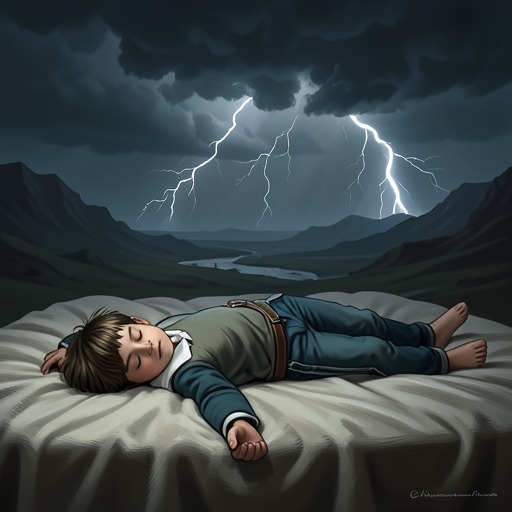
Screams suddenly carry through the house. Terrified, Mother and the nanny search room to room, initially unable to identify their source; the possibility that a monkey has escaped or that someone has fled an asylum registers how alien the sound is to the home’s established quiet. Mother looks last in her own room. There she finds the child sitting upright in its crib and howling with the force of a two-year-old. The sight overturns the child’s familiar appearance as well as its behavior. Its eyes, previously wide and fixed, had been easy to identify by their gray-green color. Now its pupils are entirely black, compared to a scorched field. The narration asks what force could have changed them so completely, but supplies no definite external cause. What is clear is the child’s fury: it is seized by a tremendous fit of rage. The blackened appearance and the howl make the awakening bodily and visible before anyone can explain it. Mother, fascinated, lifts the child into her arms. It kicks wildly, and she immediately puts it back down. Her brief attempt to hold it thus meets resistance rather than the placidity she has known. She runs through the house proclaiming that the Plant is not a plant and calls Father; the brother and sister are brought in to witness what the narration presents as a spectacle of divine fury. The household’s response gathers around the child’s newly forceful presence, even though the child cannot explain what has happened.
The Family’s Recognition and the Specialists’ Account
After a while the child stops howling, but its eyes remain menacingly dark. It regards the people assembled around it while still seething with anger; exhaustion eventually overtakes the outburst, and it lies down and falls asleep. The movement from rage to sleep does not undo the transformation. Instead, the family’s applause makes its interpretation explicit: they are overjoyed because they believe the child has at last come to life. The specialists cannot explain the sudden rebirth. Their tentative account is that the child needed two full years of extrauterine, womb-like existence before becoming operational. For the rage, they propose a mental event: something occurred in the child’s brain that it could not accommodate, and the gray matter was shaken out of its slumber. Neural messages then began coursing through the nervous system, and the body started to move. This is an offered explanation, not a disclosed trigger; the narration leaves the precipitating mental event unspecified.
Significance
The awakening reverses the apparent meaning of the child’s stillness. What the family had encountered as a placid, plant-like existence ends not in gradual adjustment but in a violent, unmistakable assertion of life. Yet the scene does not present rage as a fully understood intention or as a response with a known object. It is the first legible force of the child’s changed condition: the body moves, resists being held, and directs a dark gaze at the people around it before exhaustion brings the episode to a close. The event’s form sustains the contrast between its ordinary setting and its enormous retrospective importance. The household first searches for an extraordinary intruder, only to discover that the disturbance comes from the child it has known for two years. The family can celebrate the change, and specialists can propose a neurological sequence, but neither reaction removes its mystery. By treating this unnoticed day as a human turning point and comparing it to beginnings whose traces are lost, the narration makes the awakening both intimate and historical: a private family scene becomes a model for how consequential change can arrive without warning, explanation, or public record.